
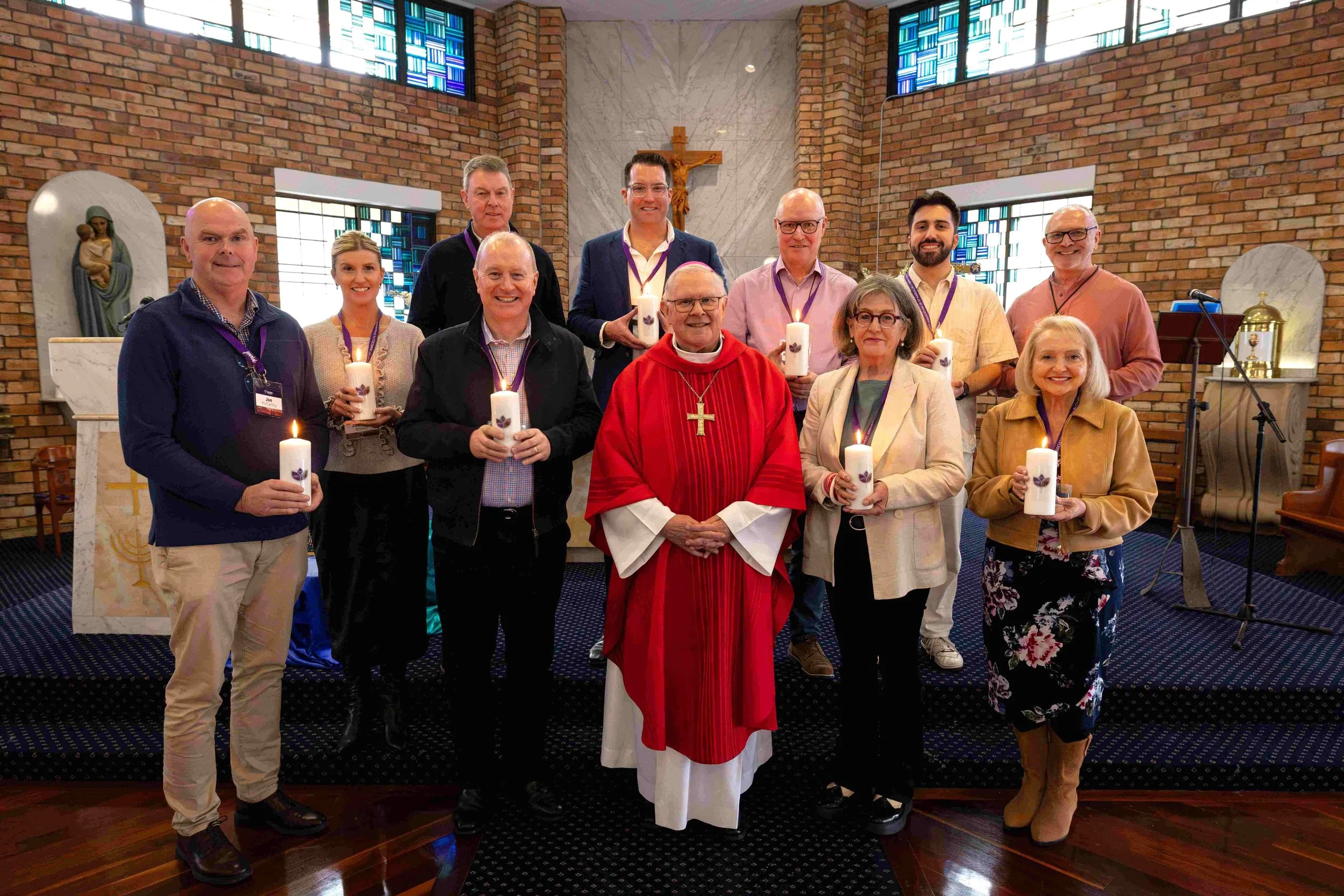
At the closing Mass of Marist Association National Assembly IV, Archbishop Mark Coleridge formally commissioned the new Association Leader, Br Darren Burge, and the incoming Council.
Bringing St Marcellin’s Dreams Alive in the World Today
To reflect on my life as a Marist is, in many ways, to reflect on the people, places and experiences that have shaped who I am and how I seek to lead and serve. My Marist story has been formed across three Marist communities - Lismore, Hunters Hill and Campbelltown - and through the many Brothers, lay Marists, students, families and colleagues who have walked alongside me.
It is a story that continues.
My journey has taught me that being Marist is not simply about having worked in a Marist school, knowing the stories of St Marcellin Champagnat or being familiar with the traditions and symbols that surround us. To be Marist is to allow the spirit and charism of St Marcellin to become part of who we are - shaping the way we see the world, the way we relate to others and, most importantly, the way we respond to those who need us most.
Yet there is an important distinction that I have come to appreciate more deeply throughout my own faith journey.
Charism must always lead us towards God and towards Jesus. It must never become an end in itself.
Our Marist identity is not intended to divert our attention away from Christ. Rather, it provides us with a particular lens through which we encounter Christ and seek to make Him known and loved.
The charism gives expression to the Gospel. It helps us understand how we might live the Gospel in a particular way, in a particular community, and in a particular time.
For us, the Marist way is profoundly shaped by Mary, our Good Mother, and by the example of St Marcellin. But ultimately, the destination of our journey is not St Marcellin. It is Christ.
This is an important reminder for me personally and, I believe, for the whole Marist family.
My educational journey has also given me the privilege of experiencing other Catholic charisms and spiritualities.
Working and leading in different educational communities has exposed me to different traditions, founders, saints, expressions of faith and understandings of Christian discipleship. Each has offered something distinctive. Each has challenged me in different ways. And each has contributed to my understanding of what it means to be a person of faith.
I have come to see this not as a dilution of my Marist identity but as an enrichment of it.
The Church is blessed by a diversity of charisms. They are different gifts of the Spirit, expressed through different communities and different people, but ultimately directed towards the same Gospel and the same person - Jesus Christ.
My encounters with other spiritualities have encouraged me to listen more deeply, to appreciate different expressions of faith and to recognise that there is much to learn from those whose traditions may not be my own.
They have also helped me understand Marist spirituality more clearly.
“Sometimes we understand who we are more deeply when we encounter something different”
My experience of other charisms has helped me appreciate the particular beauty of the Marist charism - its simplicity, family spirit, presence, humility, love of work, closeness to young people and deep devotion to Mary.
These experiences continue to shape me as a person on a faith journey. I remain a learner. I remain someone seeking to understand more deeply what God is asking of me. And I remain conscious that no charism, including our own, should ever become something that turns us inward. The purpose of charism is always mission - to lead us outwards towards others and, ultimately, towards God.
The Brothers have been central to my own Marist formation. Across the three Marist communities in which I have had the privilege to work and lead, I encountered Brothers who showed me, often through very simple actions, what it means to live a life of faith, humility, service and presence.
Their example has been far more powerful than any formal lesson could ever be.
“They reminded me that leadership begins with relationship; that education begins with knowing the young person in front of us; and that our faith must always find expression through how we treat others.”
Through the Brothers I began to understand something of the distinctive character of Marist education - a combination of high expectations and deep care, discipline and compassion, challenge and encouragement. It is about meeting young people where they are, believing in their potential and helping them discover the person they can become.
Each Marist community I have worked in was different. Yet beneath those differences was something remarkably consistent: presence, family spirit, simplicity, humility, love of work and a profound commitment to young people, particularly those who can so easily find themselves on the margins.
Those values have become part of my own leadership compass.
I have increasingly come to appreciate that charism is one of the great gifts of the Church. A charism is not simply a collection of values or traditions. It is a particular gift of the Holy Spirit that enables a community to respond to the Gospel in a distinctive way.
For the Marist family, the charism entrusted to St Marcellin gives us a particular way of seeing and accompanying young people. But charism should never become a boundary that separates us from the wider Church. Rather, it should become a bridge.
St Marcellin did not establish a movement so that people would simply admire him. He wanted young people to know Jesus Christ and to experience the love of God.
This remains our task.
At the heart of Marist spirituality is Mary. For me, Mary, our Good Mother, is not simply a figure from our history or a devotional image. She represents a way of being.
Mary’s life speaks of humility, courage, attentiveness and trust. She listened. She pondered. She responded. She accompanied. And she remained faithful, even when the path ahead was uncertain.
These are qualities that Marists need today.
In a world that can be noisy, hurried and increasingly polarised, Mary invites us to become people who listen before speaking, who notice those who may be overlooked, and who have the courage to respond when a response is required.
The Marist charism leads us to Jesus. Our schools, our communities, our formation, our service and our relationships must ultimately lead us to Jesus. When we lose sight of that, we risk turning charism into heritage rather than mission.
When we hold it clearly before us, our Marist identity becomes a living expression of the Gospel.
What does it actually mean to be Marist in the world today?
Perhaps this is the most important question facing the Marist family.
The world in which St Marcellin lived was vastly different from ours. Yet the fundamental needs of humanity have not changed. Young people still need to know that they are loved. They need adults who believe in them. Families need communities of belonging. Those who are vulnerable need advocates. And the Church and the world need people who are prepared to live their faith with courage and authenticity.
Being Marist today means taking the dreams of St Marcellin and asking: What do those dreams require of us now?
It requires us to look beyond nostalgia. It is tempting, particularly in organisations with such rich histories, to believe that being faithful to our founder means protecting what we have inherited. But St Marcellin was not a man who simply protected the past. He was a man who looked at the needs of his time and acted. He saw young people who were not receiving the education and faith formation they deserved - and he responded. He gathered Brothers around him. He took risks. He built communities. He dreamed beyond what seemed immediately possible.
That spirit remains profoundly relevant.
As a Councillor of the Marist Association of St Marcellin Champagnat, I feel both privileged and challenged by the responsibility of helping to carry this charism forward.
We must invite young people to encounter the charism, understand it, question it, own it and ultimately express it in ways that belong to their generation.
The Marist future will look different from the Marist past. That should not frighten us. It should excite us.
St Marcellin himself was an innovator. His response to the needs of his time was courageous precisely because he was prepared to imagine something different. Our task is to do the same.
Lee MacMaster
Association Councillor
Marist Association of Saint Marcellin Champagnat