
The following is an address to students at St Joseph’s College, Hunters Hill, Sydney, by Headmaster, Michael Blake. The address gained media coverage and extensive social media commentary for its bold message to the boys about sexual assault.
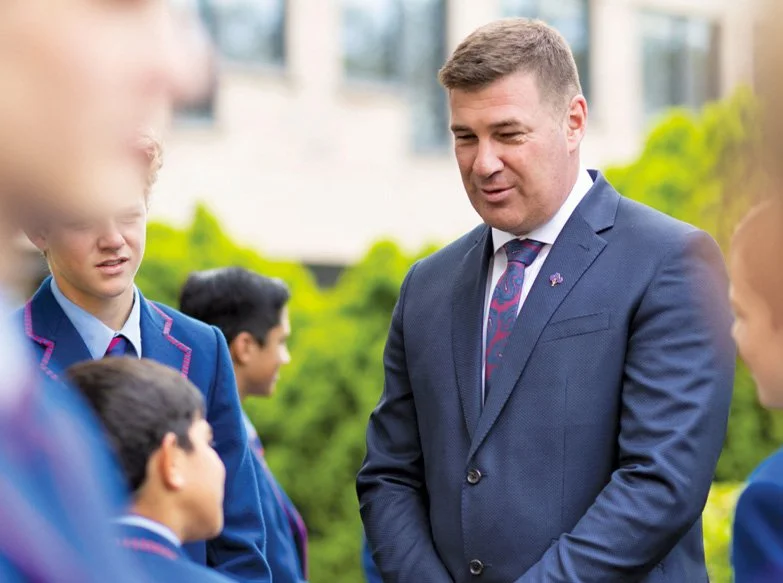
Mr Michael Blake, Headmaster, and students (Photo courtesy St Joseph’s College website).

College Assembly Thursday 27 August - Headmaster’s Address
Good morning and welcome to our College Assembly.
Boys, it has been a difficult week to be a man. As you would be aware, over the past week there have been multiple reports in the media regarding young men and allegations of sexual assault and ill-treatment of women.
It is a time when we as men, feel a sense that we are all being judged, being assessed for how we treat women. Where we look back and feel we have to justify who we are. It is a week where, in particular, all-boys schools come into the spotlight. The way we educate young men is under scrutiny. So, it has been a tough week to be a man, particularly in our setting.
I wonder if that is the way you are feeling? I hope not.
In fact, I hope that what I just said felt jarring.
I hope you were not sitting there nodding along and thinking, woe me. Because as tough as this week might have been to hear the media stories, again, it has been infinitely harder to be a female.
It has been a life-changing week for the women who are the alleged victims. We trust they are receiving the care and support they need, recognising that for those who experience sexual violence, this support must be ongoing and extend well beyond the immediate circumstances.
It would have been a hard week to be a young girl. Beginning to understand the world around her and slowly becoming aware that there are situations in which she may be vulnerable simply because she is a girl. Learning that there may be places she doesn’t feel she can walk by herself, and situations in which she needs to be careful about who she trusts.
It would have been a hard week to be a young woman, wondering whether she is being valued for the person she is, or judged simply by how she looks. Wondering whether the boy she is with will respect her boundaries. Whether the group of boys at the party can be trusted. Whether she can leave her drink unattended.
It has been a hard week to be a mother, looking at her daughter and knowing that, however much she wants to protect her, there will be times when she can’t. Wondering who her daughter is with, whether she is safe, whether the young men around her will look out for her rather than take advantage of her vulnerability. And perhaps looking at her son and asking an equally important question: What sort of young man is he when I am not there?
It has been an extraordinarily hard week to be a survivor of domestic violence, sexual assault or abuse. Because these are not simply stories in the media. A headline can bring back a room. A photograph can bring back a face. A description can bring back fear. It can reopen memories of violence, humiliation, powerlessness and the terrible experience of having your dignity disregarded at the hands of another person.
It has been a hard week for women who have never experienced these things, but who nevertheless live with the knowledge that they could. The fear of what might lurk in the darkness. The calculation about whether to walk home. Whether the person walking behind her on a dark street is simply going in the same direction, the quick look over the shoulder, whether she should cross the road, reach for her phone, walk faster. The uncertainty of whether the stranger is harmless. The message to a friend saying, Text me when you get there. The keys held tightly in a hand.
Gentlemen, here is the part I particularly want us to understand. For many women, this has not been a hard week, it is a sad ongoing reality. Because the headlines will disappear. Social media will find something else to talk about. And, for many of us, the discomfort we have felt this week will pass. But many women carry these fears, these experiences and these precautions not for a week, but for a lifetime.
So no, this is not about how uncomfortable these stories make us feel as men. But the broader issue belongs to all of us.
This week the media has focused on 3 high profile matters of sexual assault. However, in Australia there were 40,000 police recorded victims of sexual assault last year. How many true victims were there? Those who feared reporting, didn’t trust the system? Was it double, triple? tenfold?
So how do we respond?
When stories like these emerge, we can do one of two things. We can distance ourselves from them.
That’s not us.
Those boys are different.
I would never do something like that.
Or we can ask harder questions. Because the line between a good bloke and a destructive one is not drawn only at the point of criminal behaviour. It is drawn much earlier.
The front page of yesterday’s Sydney Morning Herald had an article on this very point, and it referenced the coronial inquiry into the death of Lillie James. The article highlights that we must draw the line at a sexist joke, whether delivered by a male or a female.
It is drawn when staffroom conversations make female staff feel uncomfortable.
It is drawn when a girl is spoken about as though she is an object.
It is drawn when a degrading photo is shared and someone forwards it.
It is drawn when a group chat becomes disgusting and everyone laughs.
It is drawn when pornography teaches young men that intimacy is about power rather
than dignity.
And sometimes, gentlemen, it is drawn by silence.
Because there will be moments in your life when being a good man will cost you something.
It might cost you popularity.
It might mean handing a phone back and saying, Delete it.
It might cost you a friendship because you were the one person in the group prepared to
say: No. This isn't right.
That takes courage.
And I would argue that is a far greater test of masculinity than almost anything else we
ask of you.
Because character is not revealed when doing the right thing is easy.
Character is revealed when you choose the right thing.
You attend a Catholic, Marist school. At the centre of what I believe, and what I hope you believe, is a very simple but profoundly demanding idea: every human being possesses an inherent dignity.
That is at the absolute core of this place, and while you might graduate from here anywhere from 2 months to 6 years’ time, if you have not learned that, then you have not earned the right to call yourself a Joe Boy.
Because I want every young woman who encounters a Joe Boy to be safer because you are there. Not merely safe from you - Safer because of you.
Because you notice, you step in, you shut down conversation. You are the bloke who understands that consent is not something to be negotiated, pressured or assumed. You are the bloke who is prepared to lose social currency rather than lose integrity.
Because culture doesn’t change because of an assembly speech. It doesn’t change because the media tells young men that they need to do better.
Culture changes when you are intentional about the type of man you want to be, you set your own high standard and lean into it.
Meliora Contende
Michael Blake
Headmaster
St Joseph’s College Hunters Hill
Reproduced with permission.