We are indebted to Br Peter Rodney for researching the story of Br Owen Breen, and bringing him back to mind.
During some recent research in our Archives the name of a Brother Owen came to light, along with the recognition that, because of the difficult circumstances of his life and death, he had been overlooked in the compilation of such sources as the Necrology. This short summary of what we know about our Brother Owen may help solve that deficiency.
His name was John Thomas Breen and he was born on 21 October 1886 just outside Sarina, to Patrick Breen and Mary Brennan. There were four siblings, among whom both of the daughters entered the Sisters of St Joseph and one son became a priest.
Sarina is a coastal Queensland town 300 kilometres north of Rockhampton. What led John to even hear of the Marist Brothers in that far-flung location at a time in which there were none of us in Queensland must remain a mystery.
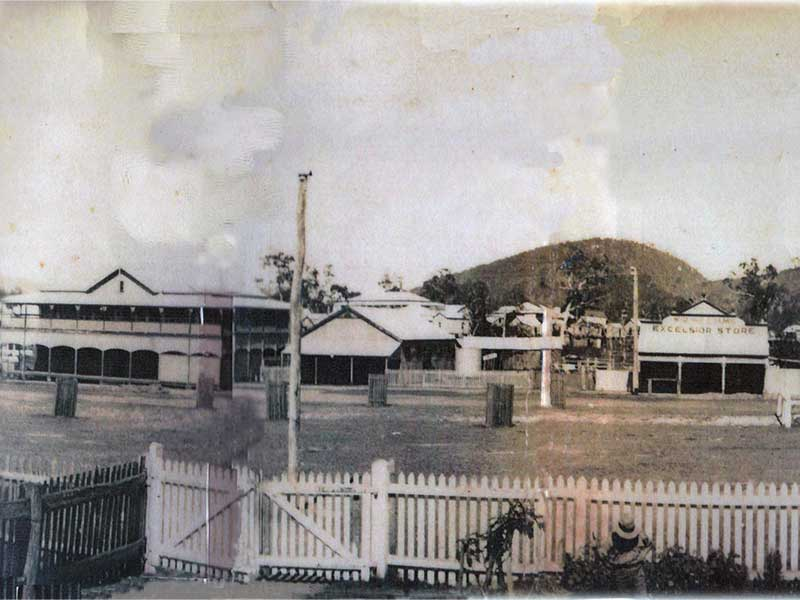
There are no found photos of Br Owen Breen in the Province Archives, but here is an image of his hometown, Sarina, Queensland.
Joining the Marists
He entered our Juniorate at St Mary’s Cathedral in Sydney on 17 January 1903, making him 16 at the time. He began his postulancy at St Joseph’s on 21 June 1904 and was given the Habit on 19 March 1905, receiving his new name of Brother Mary Owen. He made First Vows on 19 March, 1906. Everything so far seems very standard and normal.
But his record of employment and his community placements tell a different story, going by the little evidence we now have. They suggest a man who must have struggled in school and in community, since they are mostly short stays of a year or two, in many different locations ranging from Villa Maria, to Lismore, to St Benedict’s, to Glenelg, to Maitland, to Campbelltown, to Kogarah – twenty- seven shifts in all. From his Personnel Card, completed in his own hand, we know that in all these places he taught middle and lower primary, in between spells of cooking for the Brothers.
Australia at the Time
“There was no universal health scheme such as we have now. Mental health was neglected and misunderstood, even among medical practitioners”
In trying to make sense in our own times of the life of a Brother now long gone, we must understand we are speaking about a very different Australia. Times were poor and conditions tough, never mind the trauma of two World Wars. There was no universal health scheme such as we have now. Mental health was neglected and misunderstood, even among medical practitioners. Among the Brothers and our helpers there were no personnel devoted exclusively to care of the sick. Accommodation for the sick, such as it was, ranged from the timber “Infirmary” building at the Novitiate, to primitive cells in the Long Dorm at Mittagong, or a few bare rooms in an area within St Joseph’s College, christened, mischievously by the Brothers as “Bomb Alley”.
A History of Illness
On reading Brother Owen’s file, it is obvious we are dealing with a sick man, and mentions of “amnesia” begin to crop up. In the more copious notes from the Annals of Eastwood in the 1940s, where Owen was stationed, we get an even clearer picture: “18 October Brother Owen unwell; 23 October Brother Owen begins school again; 27 October Brother Owen gets up but does not teach; 8 November Brother Owen sick again; 22 November Brother Owen disappears from his room; Ryde police advise us to get in touch with relatives at Sarina; 27 November Brother Owen found by Ryde police on Lane Cove Road.”
Final Days at Mittagong
It seems that, shortly after these episodes, on January 9 1945, Owen was transferred to Mittagong, where, even though there would be scant medical attention, he would at least be relieved of the strain of teaching. Shortly afterwards he disappeared from the Mittagong property. Those who know the area would recognise it offers multiple opportunities for getting lost: vast tracts of untamed bush punctuated by the headwaters of the Nepean River. There were strenuous searches for him made by the novices and others, but no trace of him was ever found. Enquiries made at our instigation by the parish priest of Sarina were fruitless. We tried similar searches much later (1979) of government records but these also drew a blank: no person of that name had been recorded as deceased.
Gradually, Owen’s name and the trauma of his disappearance faded from memory. It is only just and fitting that we include him now among our loved confreres, and recognise in him a man who struggled in religious life, but did not give up. As the precise circumstances and timing of his death cannot be determined, our records have assigned to Brother Owen a notional date of death of 25 January 1945.
We pray now with the confidence that Mary, our Good Mother, received him at the end and recognised in him one of her Son’s faithful followers.
Br Michael Flanagan
Province Archivist