
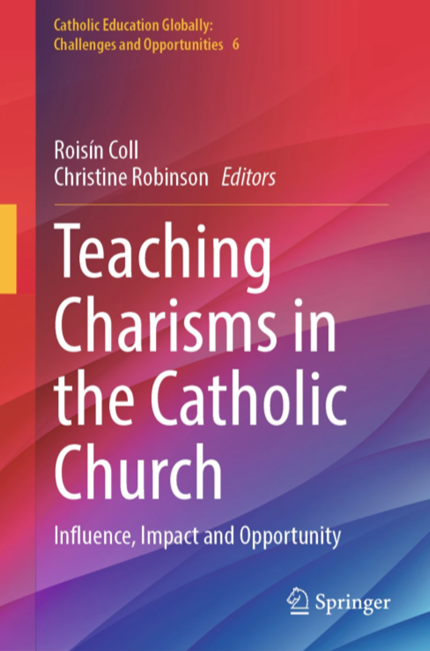
Catholic education worldwide is undergoing a significant transition as responsibility for mission and identity shifts increasingly from religious congregations to lay leaders and governing bodies. Teaching Charisms in the Catholic Church: Influence, Impact and Opportunity (Springer, 2026) addresses this reality by exploring how the founding charisms of teaching congregations continue to shape education in new contexts.
“At the heart of the book is a clear understanding of charism as a Spirit given gift”
At the heart of the book is a clear understanding of charism as a Spirit given gift, expressed through lived practices and cultures rather than static forms. It is not a legacy to be preserved unchanged, but a living mission to be reinterpreted in each generation. This aligns strongly with the Marist commitment to “creative fidelity”: remaining faithful to Champagnat’s vision while responding imaginatively to contemporary realities.
Br Michael Green’s chapter, “New paradigms for Marist communion and co responsibility,” highlights a decisive shift from congregation centred leadership to shared mission among religious and lay partners. Charism is transmitted less through the presence of religious and more through relationships, leadership practices, governance, and culture. Authority is exercised within a logic of communion, placing responsibility on leaders and boards to steward and animate Marist identity.
A central insight emerging from the work is that charism endures only when embedded in a living community of faith that owns and continues to develop it. Structures alone cannot sustain spirituality. A charism lives where it is consciously practised, reflected upon, and allowed to grow. From such communities emerge future leaders, scholars, formators and governors, ensuring both continuity and renewal.
This has clear implications for our Marist context. The primary focus must be on nurturing a vibrant Marist spiritual family marked by vitality and integrity. This is the distinctive contribution of the Marist Association: fostering a broad, participatory community in which most members are engaged in Marist life and mission at the grassroots level. From this lived experience, authentic leadership and governance can emerge.
“While governance structures remain essential, the Marist pathway begins with a faith community”
In this respect, our Marist approach differs from some other models that prioritise boards or trustees as the starting point for sustaining charism. While governance structures remain essential, the Marist pathway begins with a faith community - belonging, formation, and shared mission - and develops leadership and governance from within. This represents an importantly different “new paradigm,” and a concrete expression of “creative fidelity” in our time.
A key contribution is the insistence that charism does not endure by default. Without intentional formation, as we have through our Marist formation programs, it risks becoming superficial or symbolic. Sustained formation - especially of leaders and governors - is therefore a strategic imperative linked to mission integrity and organisational sustainability.
The book also reaffirms the core characteristics of our Marist charism: presence, simplicity, family spirit, love of work, and Mary as model of discipleship. Together, these form an integrating framework that gives Marist education its distinctive character.
For boards and advisory councils, this means stewardship goes beyond compliance and financial oversight. It involves testing decisions against mission, ensuring leadership alignment with charism, and seeking evidence that Marist identity is genuinely lived in practice. In a lay led era, it prioritises governance for mission.
In summary, the book affirms that our Marist charism remains a vital gift. Its future lies not in preservation alone, but in our conscious, communal, and courageous stewardship - ensuring that St Marcellin’s Marist Project continues to be lived with creative fidelity today.
Richard Quinn
Executive Director