
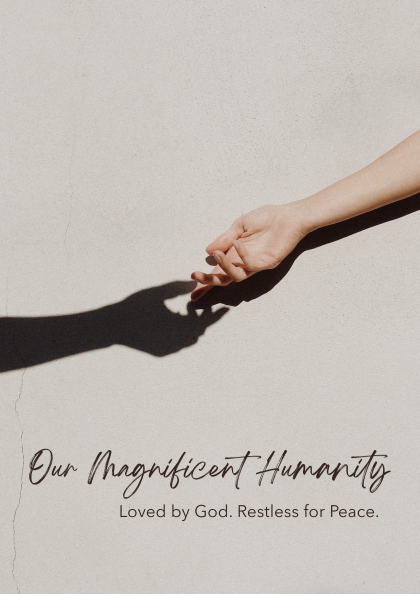
Our Magnificent Humanity: Loved by God. Restless for Peace
Recently, after a heavy snowfall, a father was walking with his children. One child stopped, looked across the brilliant white landscape and exclaimed, “Dad, look how beautiful it is. It looks like it was made by AI.” The father smiled, but later said that the comment unsettled him. He wanted his son to know that some things are beautiful not because they are programmed or generated, but simply because they are made by God for us to enjoy.
The child’s observation captures something profound about our moment in history. Artificial intelligence is reshaping the way we learn, work, communicate and create. If AI can write, compose music, generate images and even perform tasks once seemed only possible for human beings, it leads us to ask: What does makes us uniquely human? And more importantly, how can this powerful technology be used in ways to help human beings to flourish, become more loving, and build a more compassionate united world?
These are the questions at the heart of Pope Leo XIV’s encyclical Magnifica Humanitas. While it speaks about artificial intelligence and technology, its deeper concern is humanity itself: who we are, why we matter, and how human dignity can be protected in a rapidly changing world.
These questions also lie at the heart of our theme: Our Magnificent Humanity: Loved by God. Restless for Peace.
The Christian answer begins with a truth both simple and extraordinary: we are loved by God.
Before we achieve anything, produce anything, or succeed at anything, we are loved. Every person is created in the image of God and possesses a dignity that does not depend on usefulness, productivity or status. This dignity is not something we earn or achieve. It comes from the God who calls each of us by name and delights in our existence. This is what makes us unique before anything else.
Yet we also know we can be vulnerable and fragile. We make mistakes, need the help of others, and experience both joy and sorrow, love and loss. When we accept our own limitations, however, we become more understanding of others. We recognise that they too carry struggles and hopes. In this way, we discover that it is not our perfection but our humanity that makes us magnificent! As we embrace our humanity it helps us look beyond ourselves, see the worth of others, and grow in our capacity to love.
And there is another truth about being human. We are not only loved; we are also restless.
Deep within every human heart is a longing for meaning, belonging, justice, beauty and peace. Saint Augustine captured this longing when he wrote, “Our hearts are restless until they rest in you.”
This restlessness is not a weakness but a gift. It is a holy restlessness that shares in God’s own desire for peace in a world often marked by division and indifference. It moves us to care for others, to seek dialogue and reconciliation, and to work for peace. And peace begins in the heart. Before we can bring peace to others, we must first find it within ourselves.
As Pope Leo writes:
“Peace is a gift from God, the gift we receive when we invite the Lord into our hearts. Believers are then called to become instruments of God’s peace, spreading it to families, communities, nations, and the entire world.”
But what does it look like to be an instrument of God’s peace?
In the parable of the Good Samaritan, Jesus gives us an answer. The Samaritan sees a wounded stranger by the road and responds with compassion. He crosses boundaries and acts. He shows something no technology can ever generate: mercy, presence, sacrifice and love.
The Samaritan’s question is not, “What will happen to me if I stop?” but rather, “What will happen to this person if I do not?” That is the question of someone becoming fully human.
As Marists, this remains our mission: to help people become fully human, people of courage, compassion, love and peace.
And there is reason for hope. Indeed, these may be some of the most hopeful words in Pope Leo’s entire encyclical:
“Even in the darkest nights, the Lord raises up men and women who refuse to give up, who persevere in doing good, who protect the vulnerable and open pathways to reconciliation.”
The world has not run out of such people. In fact, it needs them now more than ever. It needs us.
In the words of Magnifica Humanitas:
“Let us join forces in building up the common good so that humanity will never lose its beauty, and the world once again will come to recognise the human heart as the place where God desires to dwell.”
May we never forget our magnificent humanity. May we discover anew the beauty and dignity within ourselves and others. And may the love of God, revealed in Jesus, awaken within us a holy restlessness for peace.
Tony Clarke
Director
Mission and LIfe Formation Team