
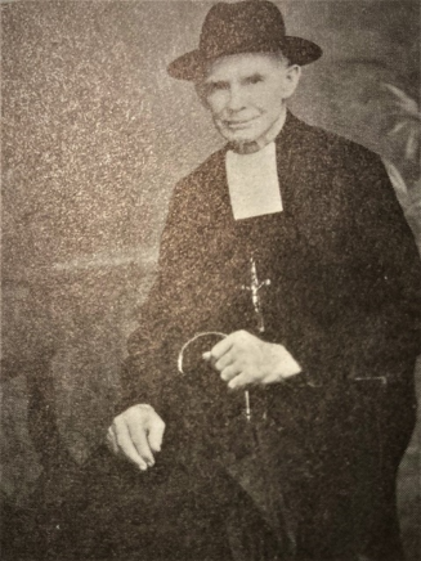
A Marist Pioneer in Fiji - Part One
Br Michael Flanagan, presenting words by Br Brian Etherington
Br Alphonsus died in Suva, Fiji on 24 April 1956, at the age of ninety-one. His funeral, which took place that very afternoon, was attended by a huge crowd. A mile long double line of children paid their last respects as his body was driven slowly in the hearse to his last resting place. The cortege of cars following the coffin must also have been a mile long. This was a fitting tribute to a man who had spent most of his adult life developing educational opportunities for the children of the colony.
His endeavours had earned the gratitude of all, especially the Indian community, for being a major agent in providing primary and, later, secondary school education for their children. The colonial government three years earlier had honoured him by recommending to the Queen that he be awarded the Order of the British Empire
for his devotion to the cause of education in Fiji, an award which the Queen personally presented to him during her visit in December 1953.
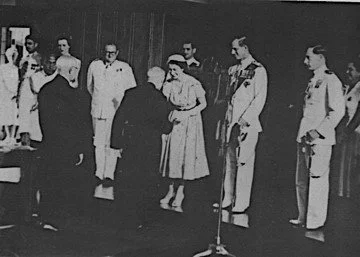
Br Alphonsus receives the OBE from Queen Elizabeth II at Government House, Suva. December 1953. Accompanying him is his friend and pupil Br Herbert Marinon.
The following is an outline of the life and character of this extraordinary man.
Br Alphonsus (Archibald) Philson was born on 20 February 1865, the second child of Thomas and Ellen Philson, a farming couple. The Novitiate Admittance Register records he was born at Largo, probably a misspelling of Largs, a small town close to Maitland in New South Wales. Archibald had six younger siblings, two brothers and four sisters, the youngest, Bridget, dying in 1972. Two of his sisters joined the Lochinvar Sisters of St Joseph and lived their entire lives in that congregation.
Archibald Philson enrolled at St Joseph’s College, Hunters Hill, as a 17-year-old on 17 July 1882. The SJC enrolment register spells his family name as Filson. His address is given as D.B. Hollow, which stands for Doughboy Hollow, a town which no longer exists. It was renamed Ardglen on 29 June 1893. Today it remains a village on the main north railway, and close to the New England Highway, in the Liverpool Plains Shire local government area.
Br Priscillian, his first biographer (1), describes Archibald’s early life thus, ‘As a young lad he helped his father in an outback farm. The work was hard and the hours of labour were long. There were trees to fell, fences to erect, fields to clear and plough and later, when the golden harvest appeared, there were the reaping and the threshing besides the mustering and shearing of sheep. The youth revelled in this kind of work.’
“He could ride, shoot and plough with the best of them. He loved the bush and the freedom of the outdoor life and eagerly looked forward to the day when he could take over management of the farm.”
Priscillian’s rather romantic description probably comes from many conversations he had with Alphonsus over their years together in Fiji.
Google describes the contemporary farming scene of Ardglen as follows: Ardglen (located in the Upper Hunter and Liverpool Plains region of NSW) primarily practises livestock grazing (sheep and beef cattle farming) and mixed crop-and-livestock farming. The area sits within the traditional wheat-sheep zone of New South Wales, transitioning between pasture and cropping lands.
It seems that the Philson farm would have fitted into this description.
Archibald arrived at St Joseph’s in the early days of the college, and the first headmaster, a Frenchman, Br Emilian, must have formed a very favourable impression of him because he entered the novitiate as a postulant on 2 February 1883, and on 2 July he received the habit and began his novitiate under the tutelage of Brother Ludovic. He made the vow of obedience on 2 July 1884. His first appointment was to St Francis, Haymarket, in 1884, followed by Sacred Heart Darlinghurst in 1885-7. Both were primary schools.
Br Priscillian describes these early teaching periods as a time of his breaking in, or training, as a teacher. He tells us that this young Brother with his country background was never at home in the great city and when the then Provincial, Br John Dullea, called for volunteers for the new foundations in Fiji and Samoa, he eagerly offered his services.
Shortly after his final profession he was one of three Brothers chosen by Br John Dullea to begin the Marist Brothers teaching mission in Fiji.
The decision to send Brothers to Fiji was the Institute’s response by the Superior General to a request for Brothers from Bishop Vidal S.M, recently appointed Vicar Apostolic of Fiji. The selected three Brothers reached Suva on 27 August 1888. The Director was Br Harvey (Hervieux) Reynaud, aged fifty-three, an older man with many years teaching experience in France and then some time teaching in Australia (he arrived there in 1880). By this time, he had a good command of English. The second Frenchman, Vincent Degruel, aged twenty-five, came straight out from France and faced the challenge of learning English. All three of them spent the rest of their teaching lives in Fiji, and all died and were buried there.
Their first school was opened to provide primary education for the children (boys) of the Europeans living in Suva. These Europeans were mostly traders and government officials. The school started with an enrolment of fifteen pupils, but this number increased rapidly. It was the education of the boys from Catholic European families that the Bishop had in mind when he requested Brothers.
One of the needs the Brothers became aware of was the lack of any educational opportunities for Indian boys in Suva. Indians started arriving in Fiji as indentured labourers under a policy begun by the first resident colonial Governor, Sir Arthur Gordon, in 1879. Soon, there was a sizeable population of Indians living in Suva itself.
It was not long before leaders of the Indian community requested help from the Brothers. Br Alphonsus worked hard to provide a school for these non-Christian boys, negotiating with the Church and the higher Marist superiors till his efforts achieved the opening of the very first school for Indian boys in Suva, by two Marist Brothers, on 23 August 1897. (2)
Within ten years the Fijian Marist mission had grown to eight Brothers, five in Suva staffing the European school, as well as a school for Indian boys. And three at Cawaci on Ovalau in charge of the “College for Fijian Chiefs.”
During this period of growth, Brother Alphonsus gradually assumed positions of leadership. By 1896 he oversaw both the community and school in Suva and in 1900 was appointed visitor to all three communities then existing in Fiji (Suva, Cawaci, Naililili).
Two events occurred in 1912 which showed the esteem in which Br Alphonsus was held, both by the citizens of Suva and then by his own higher superiors.
“Firstly, at the beginning of 1912 the citizens of the growing town of Suva demonstrated their appreciation of Br Alphonsus‘ worth and influence by electing him as a member of the Suva Town Council.”
Secondly, Br Alphonsus was appointed Provincial of the then Province of Australia in 1912, on the advice of Br John Dullea, now an assistant general on the General Council at St -Genis-Laval. Br John, being Provincial when Alphonsus was appointed to Fiji, and continuing in that role for some time after, would have known him well. (3)
At the completion of his three-year term as provincial he returned to Fiji to become principal of the newly established St Felix school for European and part-European boys in Suva.
When he completed his time as principal at St Felix, Br Alphonsus was mostly involved in working in the Indian school of St Thomas in Suva, where he spent thirty years, including his time as principal from 1928-35.
Apart from a brief period of being on charge of the Fijian school at Cawaci in 1907 and in later years (1935-37) as principal at Nalilili (another Fijian school), Br Alphonsus spent most of his active life in Suva itself.
(Look out for Part Two of this article in the next edition of Christlife.)
Br Michael Flanagan
Province Archivist
Footnotes:
1. Shortly after Br Alphonsus’ death the General Administration commissioned and published a short life of Br Alphonsus in the form of a booklet. The author was an Italian Brother, Priscillian Blanc, who also spent most of his adult life in Fiji, contemporaneously with Alphonsus, and would presumably have known him well. I have used a lot of the information in this booklet when writing this article. Quotes from the booklet sprinkled throughout the article are unacknowledged but are in italics.
Br Priscillian was born in Northen Italy. He sailed as a Brother to Australia with three companions while only sixteen years of age, in December 1912, to help found St Illdephonsus College at New Norcia. From there he was appointed to Fiji in October 1913. He taught there for twenty-eight years and remained in Fiji for the rest of his life. He is buried at Suva.
2. The colonial authorities at the time did not allow schools to enrol children of different races together. In order to meet the request of the Indian community, the Brothers were obliged to open a school for Indian and other races separate from the one for European boys. This school, known as the Indian, or cosmopolitan school (it also enrolled other non-European boys such as Chinese and Islanders), opened in 1897 and flourished particularly under the leadership of Brother Claudius Goutagny, a Frenchman appointed in charge of the school in 1902. He had previously done much work in boosting the Brothers’ school at Parramatta, in New South Wales.
3. I do not wish to include any discussion of Br Alphonsus’ term as Provincial in this article apart from this brief footnote.
Br Alphonsus was appointed Provincial of the then province of Australia in 1912, on the advice of Br John Dullea. (Bear in mind the province was covering the same area of Oceania as the present Star of the Sea Province). He was the last of a series of Provincials who served three-year terms. (Stanislaus Healey, Victor Ludeke, Paul of the Cross preceded him). Br Clement Murray followed and remained Provincial for ten years. Following his term as Provincial, he returned to Fiji, where he spent the rest of his life.
At the time of his appointment, he had been in Fiji for over twenty years.
As mentioned in the recent history of the Australian Province, Sub Tuum Presidium, the two major things which occurred during his time as Provincial were, firstly, the exchange of property with the Sisters of Mercy in Kilmore, which allowed for Assumption College to develop its full potential, and the opening of St Ildephonsus College at New Norcia. Since both events occurred in 1912, both were already in train before his appointment.