
Dr Frank Malloy served as the Executive Officer for the Marist Association of Saint Marcellin Champagnat for seven years, between 2017 and 2023. At the invitation of the editor, Frank was asked to share some reflections on the development of the Association as he concludes 15 years as a Regional and National Director with Marist Schools Australia.
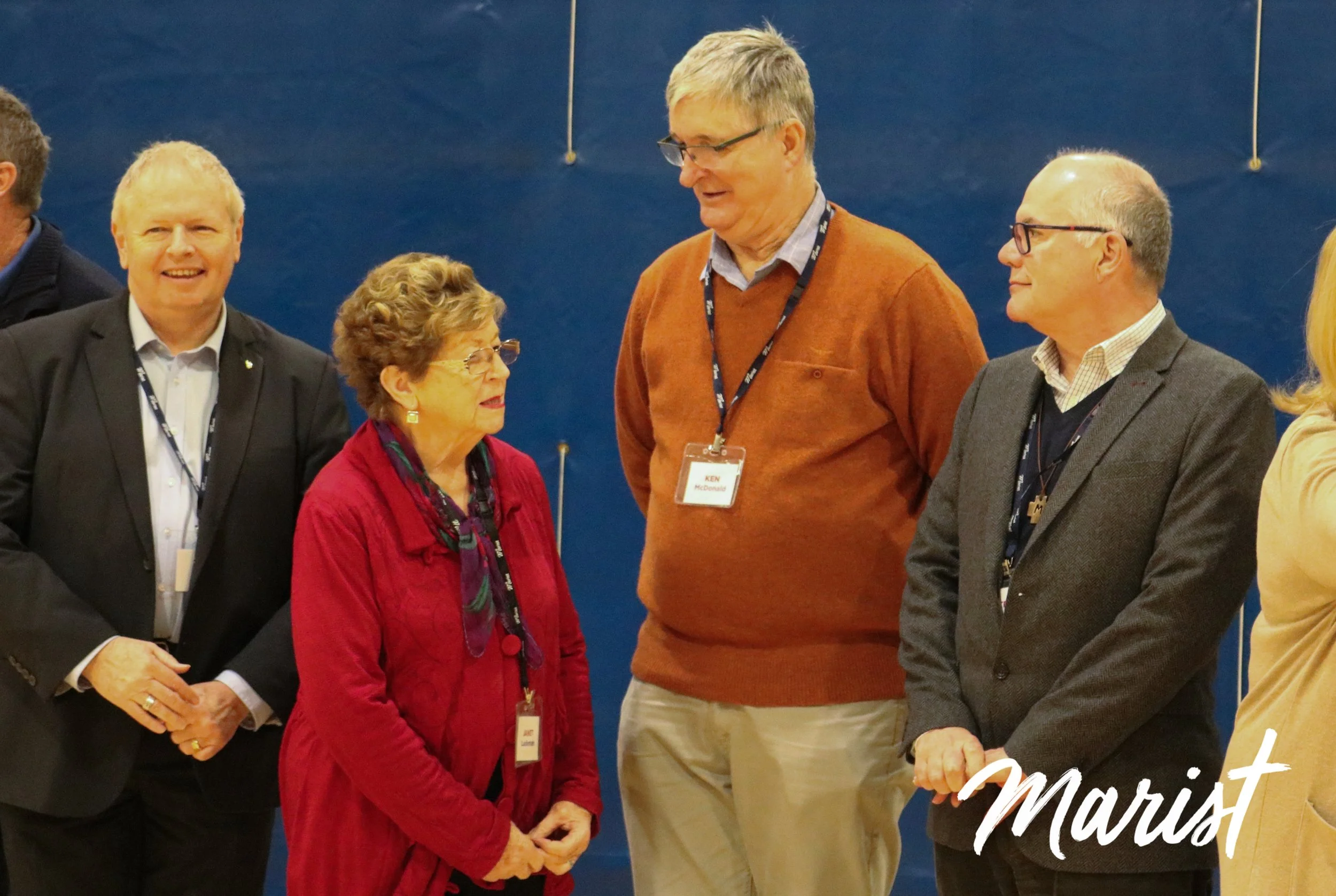
An image from the 2018 First Marist Association National Assembly in Adelaide.
INTRODUCTION
Founded in 1817 in southern France by Father Marcellin Champagnat, who was canonised in 1999 by Pope John Paul II, the Marist Brothers have had an uninterrupted presence in Australia since the 1840s. In 1872, the first Marist School commenced in the Parish of St Patrick’s at The Rocks in Sydney.
For the past 153 years, the Marist Brothers have made a significant contribution to Catholic education in Australia in schools and at the tertiary level. Ministries in Australia and in neighbouring developing countries, to provide welfare support and educate marginalised youth, have also been developed.
AN HISTORICAL GLIMPSE
Over the past 200 years, Australia has undergone massive change. The arrival of Europeans in 1788 decimated the first people, their culture, and their land. The plight of our indigenous people is an unresolved and hurting reality today. The majority of early European settlers were either convicts or political refugees from England and Ireland. The population in Australia exploded in the 1850s and 1860s with the discovery of gold. The different “colonies” that governed the vast continent only became the States and Territories of the new Federated Commonwealth of Australia in 1901.
In the first six decades of European settlement, formal education was largely provided by Christian Churches, with modest funding from government. With the Gold Rush and the country's increased wealth, political leaders recognised the need for a strong public education system administered by the government and free for all children. By the 1870s, the strength of ideology behind public education saw legislation passed in every colony that ensured government funding for public, government-provided school education. The Church schools that had been in existence and growing in number had their financial support from government removed.
The resultant response from the Catholic community, a poor but spirited, and mainly Irish minority, was unexpected and the catalyst for what is widely considered the most significant contribution the Catholic Church has made to Australian society. The Australian Bishops urged parents to keep their children in Catholic schools, whilst sending urgent requests to the major teaching Religious Orders that were flourishing in Europe. The Orders responded, and within a short time, many young Australian-born Catholics would join their ranks. Over the next 90 years, Catholics in Australia built and conducted growing numbers of schools with no government funding. The teachers were almost exclusively religious men and women. By the 1960s, Australia’s population had grown exponentially in the aftermath of WW II, and the number of religious per capita in Australia was among the highest in the world. Catholic schools were by then educating 20% of the country’s children, and the demand on the Australian government to build new schools was unprecedented. It became apparent at this time that the non-government school sector in Australia was now essential to the nation in the provision of education. Funding from government commenced and increased over the next 50 years to between 60-80% of the cost of educating a child in a government school.
By the late 1960s and early 1970s, government funding for Catholic schools, the changes and impact of Vatican II, and a sharp decline in the number of religious vocations saw the teachers and leaders in Catholic schools change markedly in a little over a decade. In 1972 for example, the percentage of Principals who were religious men or women was close to 100%. By 1992, this percentage was less than 5%.
Throughout the 1980s, reading the signs in those fast-changing times, the Marist Brothers recognised a need for greater emphasis and resources to be invested in the spiritual formation of lay teachers. The vast majority of lay teachers at this time, and since, have been people of extraordinary commitment and generosity. As teachers in Marist schools, they have demonstrated an authentic desire to integrate faith and work life and have resonated strongly with the intuitions and inspirations of Saint Marcellin Champagnat. The Marist Brothers in Australia have now, for nearly 40 years, prioritised formation for lay Marists. The fruits of that work and purposeful intent have been the foundation from which a new movement has emerged.
Founded in 2015, the Marist Association of Saint Marcellin Champagnat is an active, committed and faith-filled group numbering over 1100 members. Arguably the most decisive development in Australian Marist history since the foundation of the Brothers in 1872, the creation of the Association has helped to formally identify and gather groups of committed Marists, Brothers and Lay, from across the country. Members engage in different ways and to varying levels. The establishment of over 50 “local groups” has assisted in sustaining and nourishing their shared Christian vocation. Importantly, the Association elects a Council of leaders. This Council has delegated governance responsibilities for certain ministries and works of Marists by the Star of the Sea Province.
NEW MOVEMENTS
The post-Vatican II era has seen the emergence of a range of new movements within the Church. Some are well known: Community of Sant’ Egidio, Catholic Action (which started in the 1920’s but evolved further in the 1960’s), Charismatic Renewal, Cursillo, the Neochatechumenal Way, Opus Dei, the Focolare. Others are more local and have a limited profile. It is clear that there has been a diversification of the potential models of Christian Life within the Catholic Church – far beyond the traditional dualism of two types of Christians: clergy and laity. And this diversification continues.
Massimo Faggioli identified the features that characterise these new movements:
“...a group of Catholics with a charismatic founder, a specific charism, some form of expression of communal life or frequent regular meetings, predominantly lay membership, radical commitment to the Gospel, some form of teaching or formation closely linked to its charism with special attention and commitment to bringing its particular charism into the life of the Church”.
While our Association has grown out of an older charismatic tradition, we have much to learn from the growth and lived experience of these movements.
CHURCH AS MOVEMENT
Movements by their nature are characterised by a low degree of institutional life. This poses some challenges – though not new challenges. There has always been tension between Church-as-Institution and Church-as-movement. Both are necessary and are often referred to as the “head” and the “heart” of our Church. From an evangelising perspective, there is every likelihood that the movement nature of the Church will prove increasingly attractive in the next few decades. Pope Francis identified the evangelising impulse of such movements as a key characteristic.
A TIME OF RENEWAL
In this age in Australia, the Church is called to recapture the Christian faith and reformulate how to witness it in a dynamically different cultural, social, political and economic context. Such sentiment was pivotal in the Fifth Plenary Council for Australia in 2022. The Marist Association is part of this process of renewing the Church.
We need to be clear in our conceptualisation of the Association and particularly its relationship with the Institute. The Association is obviously situated within the Catholic Church. It has flowed from the Charism of Saint Marcellin and is a part of the broader charismatic religious family, often referred to as the Marists of Champagnat. It has emerged from the generous and selfless work of the Marist Brothers over many long years. Enduring questions to be answered in an evolutionary manner include:
What is the most appropriate relationship between the Association and the Institute, or Province?
What is the best alignment between the Association and the Institute?
To what degree is the Association autonomous from the Institute?
These are significant questions and need to be clarified through respectful dialogue and discernment in the years to come.
PURPOSE OF THE ASSOCIATION
Some people have suggested that the Association has only been created to assure the future of Australian Marist schools. This is a misinterpretation of the purpose of the Association and the reasons for its foundation. Certainly, the Association has the capacity to provide significant benefits for the institutional expressions of our spirit; especially in ensuring they remain true to their Marist identity. However, that is not the key reason for its existence. The Association is not about maintaining institutions, it’s about the Holy Spirit. In particular, it’s for people who have been captivated by the Marist spirit, given to the whole Church, and indeed the world, through St Marcellin, the early Marists, and the many Marists who have worked and lived shoulder to shoulder with hundreds of thousands of Australians over the decades. It goes well beyond institutions, and even the Institute. Our Association is about witnessing to the Gospel and living our discipleship in a particular Marist way. This then impels us into community and mission; service and evangelisation.
Our Association is first and foremost about following Jesus. If our Association is from the Spirit, we know what the fruits will be. There will be life and newness. These shared intuitions have motivated the Association’s desire to be recognised canonically as an Association of Christ’s Faithful, an aggregation of people, rather than just an aggregation of works.
PRACTICAL MATTERS
Over the last 12 years, the Association has continued to grow in numbers and in public recognition. We have a highly professional Association Council, which continues to discharge its oversight and governance responsibilities most carefully. We have employees who are committed to the Association, and structures that have supported its growth. The Institutional Ministries, Marist Schools Australia, Marist180, Marist Youth Ministry, and Australian Marist Solidarity, are serving tens of thousands of mostly young people. Local Association groups have emerged and are developing their life and identity.
CIVIL & CANONICAL RECOGNITION
Civil recognition
In 2015, the plan was to have the Association incorporated under the 1942 NSW Catholic Church Community Land’s Act. By 2017, becasue of changes in the regulatory environment for Not-for-Profit organisations throughout Australia, ministries of the Catholic Church were encouraged and advised by government and the Australian Bishops to establish governance arrangements under the Commonwealth Corporations Act. The Marist Association of Saint Marcellin Champagnat was incorporated in January 202,2 as was Marist Schools Australia. This development formalised in Australian Law the relationship of the Association as “Member” of the Company “Marist Schools Australia”.
Canonical recognition
Since 2016, the Vatican, through the Congregation of Institutes of Consecrated Life and Societies of Apostolic Life (CICLSAL), has twice rejected our petition to have the Association established as an international Public Association of Christ’s Faithful. CICLSAL’s grounds for rejection were communicated in letters to the Superior General of the Marist Brothers in February 2017 and February 2018. In broad terms, the proposal was not consistent with that Dicastery’s terms of reference or decision-making power.
A further option was encouraged by the Vatican, which entailed re-submitting the petition to the Dicastery for Laity, the Family and Life (DLFL), which was established in 2016, and was advised to be the relevant agency to approve such an Association. Whilst enthusiastic and supportive, that Dicastery indicated that the Association needs to be existent in more than one country and be of a sizeable nature in regard to membership to be recognised by that body. For the time being, canonical authority for the Association continues to come from the Marist Brothers Star of the Sea Province.
It is still hoped that the Association will gain canonical identity in the near future. Important to note is that the Association’s original intention was to seek recognition through CICLSAL at a national or local level. It was the Institute, through then Superior General, Brother Emillii Turu fms, who instructed that the application be made for an international public association of Christ’s faithful. Recognition at the national level with the Australian Catholic Bishops is the current goal.
Personal reflections
It has been a privilege to serve the Marist Association, especially in the development of processes and procedures, that will hopefully endure, helping to shape and strengthen its future in service, encouragement, and leadership on our shared journey in Faith. Whilst the work undertaken in the nascent years of the Association will be remembered fondly for its importance and significance, the friendship, laughter and overwhelming sense of the Spirit evident in those with whom I worked will be what warms the heart and brings a smile in the years ahead.
Frank Malloy
National Director Marist Schools Australia
Former Executive Officer
Marist Association of St Marcellin Champagnat

[1] Illustrative of this reality is that among the national network of 58 Marist schools, 12 are directly governed by Marist Schools Australia Ltd, two are governed by their own incorporated boards that include Marists, and the rest are governed by Diocesan Catholic School offices whilst being distinctly Marist in their spiritual tradition and expression