
Seen through the eyes of Brother William Molloy - Part One
(If you have read Part One in the Christlife August edition, you can scroll down the page to Part Two)
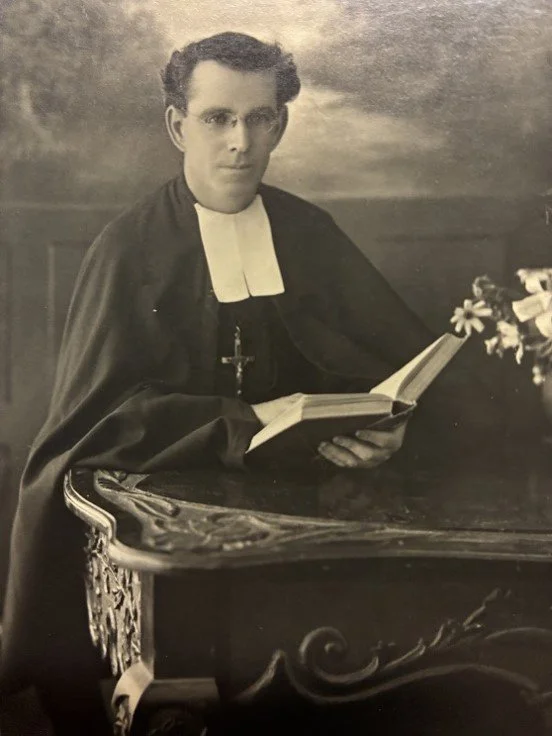
Br William Molloy, 1917, West Maitland.
Brother William Molloy, one of the first two Marist Brothers from South Australia, was born 17 December 1883. His early Marist formation took place in Sydney, beginning at the Juniorate, at St Mary’s Chapter Hall 1, and then the novitiate at St Joseph’s College Hunters Hill.
He went on to become one of our most outstanding headmasters in the first half of the 20th century. His first headmastership was at Maitland, New South Wales (1914-20) where he founded the then Marist Brothers’ High School. He was appointed headmaster of Assumption College Kilmore, in Victoria, on three occasions (1922-7, 1931-36, and 1943). He also was headmaster of the then St Patrick’s College Sale, Victoria (1928 -30), and St Gregory’s College, Campbelltown, New South Wales, (1937-42).
Brother William wrote extensive notes about his earlier life - mostly put together after his retirement as submissions to Brother Alban Doyle, as Alban was writing his book Marist Brothers in Australia 1872 -1972, which was published in our centenary year, 1972.
Fortunately, these notes have been preserved and give us some valuable insights into the Brothers’ recruitment and teacher training methods of that period as well as some of the customs and weaknesses of the then provincial administration.
As a boy, the son of James and Eliza Nelly Molloy, Laurence Molloy grew up on a small dairy farm in Rosewater, South Australia, very close to Port Adelaide.
Life on a small dairy farm must have been very tough in those days and not all that economically rewarding. There were no milking machines, and he tells us that his father rose at three o’clock each morning to get the job done manually. He hints that at thirteen years of age, the age he went to the Brothers’ school, he saw his future as helping his father on the farm.
He was enrolled as a pupil at the Brothers’ school in Port Adelaide on its opening day, 16 November 1897, together with fifty other boys all from the convent school conducted by the Sisters of St Joseph. Brother John Dullea, the then Provincial, was present and addressed the pupils. The legendary Brother Jules Stephen Debourg, a Frenchman, oversaw the founding of the school. Young Laurence was in the primary school and soon came under the spell of Brother Daniel Flaherty, an Irishman. Writing in later life he refers to Brother Daniel as, ‘a very religious man who gave soul-searching, thought provoking instructions,’ (i.e. religion lessons). It was he who suggested to the young Laurence that he should think about becoming a Marist Brother.
“‘Laurence what are you going to do when you leave school?’ I replied in words like these: ‘I suppose I shall help Dad on his farm.’ ‘Have you ever thought of becoming a Brother?’”
Brother William tells the story: ‘One day in March or April 1898, rain had fallen very heavily in the early morning hours and our small school yard - saucer shaped - had collected a lot of water in the centre. Boys, having little else to do during recreations, had made ‘boats’ of a kind with paper sails, and were conducting races. Brother Daniel Flaherty, of very happy memory, who impressed many of the pupils as a good living man, was, with the aid of the younger fry, gathering up yard papers. He heard me and he said ‘Laurence, I have a bone to pick with you! Come into my room. I followed him in…. he sat at his desk and said, ‘Laurence what are you going to do when you leave school?’ I replied in words like these: ‘I suppose I shall help Dad on his farm.’ ‘Have you ever thought of becoming a Brother?’ ‘No Brother, I haven’t.’
As I didn’t think much of the Brothers in those days - of their training, etc - I may have thought the Brothers dropped down from heaven. So, I said, ‘No Brother!’ He went on to stress the good work the Brothers could do, and realising how much he was doing for us by his prayerful conduct and his soul-stirring thoughts during the so-called Catechism period, I felt he was speaking the truth. To his further question of, ‘How would your parents take it if you were so inclined?’ I said something like this: ‘Dad would probably like me to work with him on the farm.’ He advised me to speak to my mother and father. I did rush up to Mum when I arrived home and, in a half-amused way, exclaimed: ‘What do you think Mum, Brother Daniel wants to make a Brother of me!!’ She looked and smiled not, but appeared interested and asked something like this: ‘What does a Brother do?’ I said something – perhaps this, that he teaches arithmetic, tables etc. ‘Anything else?’ I replied he taught Catechism, Bible History and other things. She replied something like this: ‘He’s the one who makes a boy good - who becomes a good living man, who dies in sanctifying grace and gets to heaven. Who puts him there? I got rid of the silly grin. She was apparently willing and eventually agreed.
I returned to Brother Daniel in a few days and said, ‘Yes, Brother, I would.’
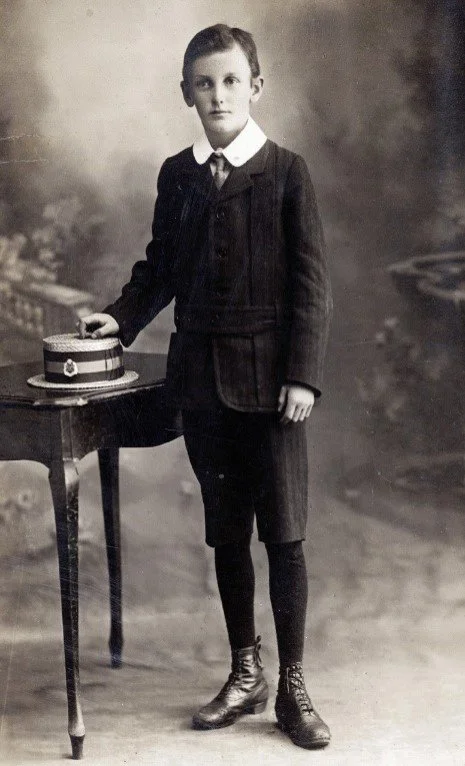
A studio portrait of James Ryan, who entered the Juniorate aged 12 in 1913, when the Juniorate was located at St Joseph’s College. He later became Brother Columba, a distinguished Marist Brother, who died in a tragic accident at Newcastle in 1950 at the age of 49. This photo is of interest because it gives some idea how the Juniors who taught as pupil teachers may have dressed. Those going to St Benedict’s in Abercrombie Street would not venture there without an accompanying adul as some had had bad experiences with the local toughs who took exception to these well-dressed intruders!
Another boy in his class, Stanislaus Ashworth, later Brother Honorius, (who presumably also fell under the influence of Brother Daniel) felt the same calling to be a Marist Brother. Together, they entered the Juniorate, at far off St Mary’s Chapter Hall in Sydney, on 23 January 1899, after a journey by boat of eight days. No trains or planes in those days! A huge step for a fifteen-year-old South Australian farm boy.
Part Two
Interestingly, two other boys, contemporaries of Brother William at the Port Adelaide school, but younger, also went on to become Brothers: Michael Byrt (Brother Sixtus) and James Burke (Brother Timothy.)
“So, it would seem recruitment depended on the local Brothers.”
Those targeted for recruitment were the adolescent schoolboys the Brothers were teaching. It is safe to say that this recruitment process was being repeated in all Marist schools all around Australia and New Zealand during this period. It was a model which remained with the Brothers till the 1970s.
Laurence entered the Juniorate just a few weeks after his fifteenth birthday. There were twenty-two boys in the Juniorate when he arrived. Of these, three died as Marist Brothers. Looking at the admission register of 1899, the origins of boys admitted that year were seven from New South Wales, two from New Zealand four from Victoria, and four from South Australia.
The following is an edited version of Brother William’s written account of his experiences in the formation houses and his early teaching days.
“We left Port Adelaide on the SS Riverina on 17 January 1899. The steamer called at Melbourne, and we reached Sydney on 23 January. We were met at the wharf by two juniors - Tom Mooney and Willie Lyons, both of whom became Brothers.”
Presumably the steamer berthed at Circular Quay, and this was within walking distance from the juniorate building.
“The ring of the doorbell at St Mary’s Seminary (now called the Chapter Hall) brought Brother Bertrand Barry, the headmaster, to welcome us with his genial smile. Later (I met) Brother Stanislaus Healy, the Director of the Juniorate and the two communities living in the catacomb-like church buildings.
If I remembered rightly, there were only twenty-two juniors present when we enrolled.
The Brothers who completed the staff were: Brother Bertrand Barry, Brother Cuthman Scott, Brother Bruno Ryan, Brother Augustine Hartshorn.
The juniors were pupil/teachers in those days, a system then prevailing in the state schools also. We taught in the lowest classes in primary schools - St Benedict’s, St Patrick’s Church Hill, old St Mary’s Cathedral school, Sacred Heart School Darlinghurst, (a primary school located where the present-day Notre Dame Darlinghurst campus is situated, not to be confused with the former Darlinghurst High School, which opened in 1911) and St Francis Haymarket.” (2)
Brother Frederick McMahon, in his book, “Not Shaken by the Wind,” gives us more detail regarding these pupil teachers. At each school there was one large room, usually with two first classes and second classes (the standard was similar to our current Year Three and Year Four). The juniors taught these four classes, relieved occasionally by the Brother, who in turn gave model lessons for the benefit of the juniors. The Master of Juniors used to visit each of the schools in turn, giving helpful lessons and practical advice.
Brother William continues: “The Brothers under whom the juniors taught gave marks - sent them to Brother Stanislaus. The maximum was five – these marks were read out each Saturday to the assembled juniors.”
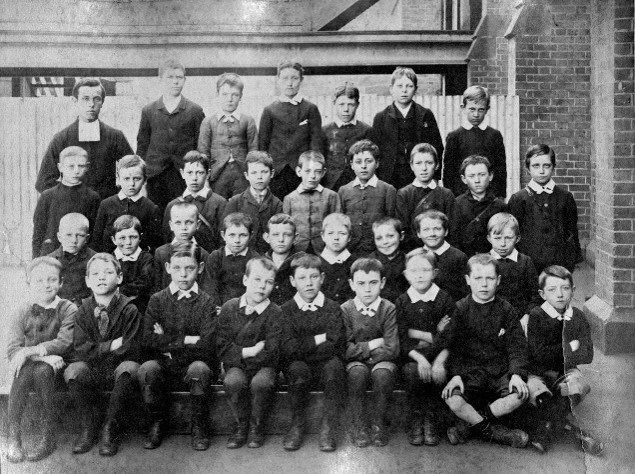
An undated photo of a 19th century class at St Benedict’s Broadway, with their unidentified teacher. These pupils may have experienced lessons from Juniors as pupil-teachers.
“ As a pupil/teacher, I first taught at St Francis Haymarket, under Brother Heinrick.” (The novitiate Register records Brother Heinrick entered the novitiate on 8/15/1875. His name was Robert Plunkett, born in Dublin 14/6/1845, and arrived in New Zealand in 1859. The Register notes he left the Brothers, but gives no details.) Brother William writes in November 1959 that he was still living somewhere in New Zealand - perhaps in retirement in Auckland. “The late Brother Fergus was in charge of the school”
Brother Fergus Gilbert is described in the necrology as a gifted teacher, a New Zealander, who taught in New Zealand and South Africa.
“After, I taught at St Patrick’s under Brother Aloysius Galbraith, often referred to as “Little Johnnie,’ as he was small in stature.”
The necrology mentions that, at St Mary’s, Brother Aloysius helped the juniors prepare for their days of teaching at school, and that although he only ever taught lower primary classes, he was thorough in grounding his pupils in the basic skills.
“Juniors left the juniorate immediately after breakfast. Those teaching at St Francis (Haymarket) and Sacred Heart (Darlinghurst) carried eatables that the Brothers placed in a small wooden box, (bread, butter, tea, jam) for Brothers and themselves - to be eaten at 12:30 pm. We left the school at about 3:45 pm. Dinner at the juniorate was at 4:30 pm in a room in the building in which the Brothers lived - not at the seminary. I think we had supper at 7:30 pm. Study was for about two hours – about half an hour of which Brother Stanislaus came up and addressed us at about 8:15pm. Then to bed.
The seminary was a two-storey building – the top portion was our dormitories. I understand it became one-storeyed after we left - perhaps many years later. It was small, even for twenty or thirty Juniors. The yard too was not a playing area - except for one handball court against one side and cricket played with handballs.
On Saturdays we generally marched to Moore Park - three deep - and we were often hailed by the cheeky elements among boys as “soupers”. Occasionally, we marched to and from Mrs Macquarie’s Chair, under the strict supervision of Brother Bertrand. We enjoyed the roaming about for one hour.”
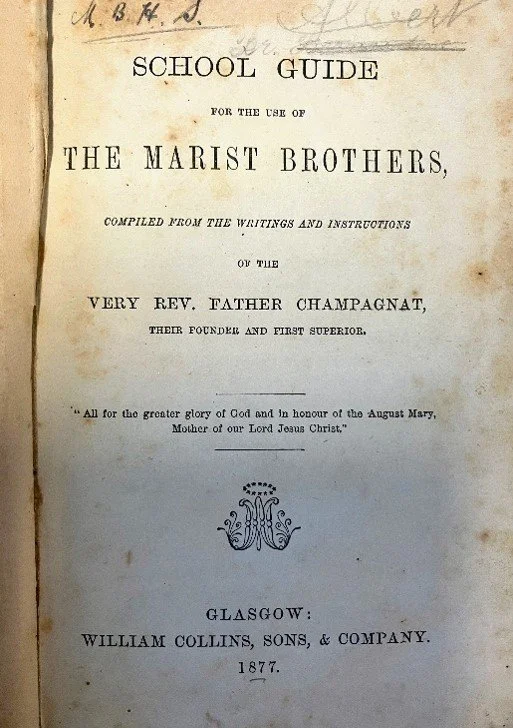
This scanned copy of the front page of “The School Guide”, found in the Province archives, was printed in Glasgow in 1877. The Scots translated and published many of the Institutes’ official books from their original French in the later 19th century. This book may have been used by one or more of the Juniors at St Mary’s during their time as pupil teachers. The initials M.B.H.S. would be identifying our then, sole Sydney high school, originally located at St Mary’s and later at Darlinghurst, and always referred to by the Brothers as “the high school”.
So, it seems that most Brothers of this period received their professional training as teacher/pupils under the supervision of older Brothers who were regarded as successful teachers themselves. Brother William doesn’t tell us what material was studied, but we can be fairly certain that the Institute’s own “The School Guide” (3) would have been high on the list. This stress on the School Guide as a major text in the pedagogical training of these adolescent pupil teachers is also mentioned by Brother Andrew Power in his written recollections of juniorate life.
Coming back to Brother William’s notes we read:
“On January 2nd, 1901, five of us entered the novitiate. Stan Ashworth (who became Brother Honorius), Vin Walsh (Brother Fabian), Martin Comer (Brother Claude), me, and Brother Raymond Guppy.
The novitiate consisted of two storeys of the northwest wing of St Joseph’s. (i.e. the wing closest to present-day Mark Street.) The first and second above the basement consisted of an oratory and a study. “
This indicates that by this time the location of the novitiate was no longer the original purpose-built novitiate building opened in 1878, prior to the construction of the present-day main college building. Perhaps it had become too small to accommodate the number of novices now entering from the juniorate.
“Across the corridor was our refectory. The conference room was above the oratory – not used by the novices- but the large room above the conference room was our dormitory, above which was the tailoring room where Brothers’ clothing was made, supervised by ex- Brother Borromeo. (4) We were in the novitiate for two years. Much of the day was given as much to secular studies as to religious matters. This was necessary, as we did little study in the juniorate. Brother Clement Murray was the Master of novices and Brother Joseph McAteer, with him, were the teachers.
The habit was bestowed six months after entrance, so we were clothed on 2 July 1901 by Fr Muraire SM.
Peter Crapp, from the Newcastle area, entered, I think, about mid-1901. He became Brother Antonius, but remained with us for perhaps five years. Said Brother Joseph to us one day: ‘A student has come to us who has matriculated!! Mr Peter Crapp’. All the novices were staggered, bewildered, and his arrival was greeted with enthusiasm. He began teaching the novices during his noviceship.”
The novitiate entry register states that Peter Crapp was educated at the Catholic School Newcastle, then spent three years at Sacred Heart College West Maitland, from which he passed the Junior and Matriculation exam.
The fact that the entry of a novice who had matriculated caused so much excitement gives us an inkling into the level of education the other novices had achieved.
Brother Alban Doyle tells us, at this time the juniors, besides working on lesson preparation at night, also studied for internally held exams equivalent to Junior Public standard.
Brother Andrew didn’t pass his Junior Certificate till well after his first profession in 1906. (6)
Brother William made the vow of obedience at the conclusion of his novitiate. In those days, the three vows were only made when the Brother made his final profession.
“I left the novitiate February 28, 1903.
My first appointment was in the primary school at St Mary’s. Brother Thomas Ludeke was headmaster. I had third class, Brother Honorius 4th, Brother de Sales Murphy 5th and Brother Thomas 6th.”
It is interesting that Brother William began his teaching in the same inner-city primary school wherein earlier days he had taught as a pupil teacher and that, in the following year, Brother Andrew did the same thing, before being appointed to a more remote school. Was this to ensure that the young newly appointed teacher benefitted from the supervision of those more experienced Brothers already supervising the young juniors beginning their teaching? We can only surmise.
“I remained (at St Mary’s) until Jan 1904 (replaced by Brother Andrew Power) when I was sent to West Maitland primary school.
In those days there was no residence for the Brothers who taught at the school. The Brothers slept at Sacred Heart College Campbell’s Hill (5) (where Brother Liguori was a boarder) a few miles away. We drove each day to and from school in a four-wheel buggy.
The Brothers at the primary school were Brother Egbert Jackson, Director, Brother Hubert Prowse and William.”
So, we have the story of Brother William’s early years in both Marist formation houses and also community. It was a pattern followed by most of his contemporary confreres. Within a short time, the pupil/teacher system was abolished both in the Marist and state schools, (circa 1904) and the Juniorate became more of a mini boarding school where the Juniors prepared for their matriculation exams and newly professed Brothers prepared for their teaching lives in other ways.
Br Michael Flanagan
Province Archivist
Footnotes:
1. The Elizabethan style Chapter Hall, constructed between 1843 and 1845, is the oldest building in St Mary’s Cathedral precinct, and was built to designs drawn up in England by Augustus Welby Northmore Pugin. He designed many churches in England, some in Ireland and Australia.
The building contractor was Jacob Inder. Initially, it was used as a Catholic school but was converted to a chapter hall in 1910.
Research suggests that the final design of the Chapter Hall was the result of successive amendments to earlier schemes for a larger structure. Colonial Architect Mortimer Lewis appears to have selected the site for the Chapter Hall, and may have been responsible for overseeing its construction.
2. In 1883 the Marist Brothers took over the staffing of three Sydney inner-city primary schools, St Mary’s Cathedral School, St Francis Haymarket, and Sacred Heart Darlington (sited on the present-day Notre Dame University campus). All these schools had previously been run by lay teachers, but the withdrawal of government funds had placed the existence of these schools in danger, hence the need for Religious to run them. Under an agreement with the then Archbishop of Sydney, Bede Vaughan, the Brothers who staffed these schools lived in community in the cathedral grounds, as did the juniors who were pupil teachers. The Brothers had relinquished all three schools by 1910 for various reasons. These three schools, together with St Patrick’s Church Hill and St Benedict’s Broadway, all within walking distance of the juniorate, became the schools where these young pupil teachers began their professional careers.
3. The School Guide (le Guide des Écoles) was published in 1853 by the second session of the General Chapter of 1852 -54. It seems to have come largely from the hand of Brother Jean-Baptiste Furet, but was edited by a commission of leading Brothers which met several times in the time between the 1852 and 1853 sessions of the Chapter. Its purpose was to ensure consistency in teaching method, curriculum, administration, and furnishing of the Institute’s schools, and to provide a theoretical-practical manual for training of young Brothers as teachers.
4. The Novitiate Entry Register contains the following information about Brother Borromeo:
His father is shoemaker by trade and is living at Parramatta. The mother is deceased. He is a tailor by trade. Has a good outfit. Gave 2/= and a silver watch. Was working in Parramatta for about 4 years where he met Brother Claudius who highly recommended him. Dismissed Weak judgement.
5. Sacred Heart College, a small Catholic boarding school, was founded by James Murray, Bishop of Maitland in 1873. In earlier times, it was run by Diocesan priests, and then the Patrician Brothers. The Marist Brothers staffed it from 1898 to 1905, when it closed, considered as unviable.
6. Brother Andrew, and others, while teaching lower primary classes at St Mary’s, used to spend their weekends at St Joseph’s College being tutored by the Brothers there to gain matriculation. To the author it seems rather strange that, although the Brothers had at least three colleges at this period preparing boys for matriculation (St Joseph’s Hunters Hill, Sacred Heart Maitland and St Mary’s Cathedral High school), they were professing novices who had much lower educational qualifications.